
Eusrunai
Unknown Artist
late 19th century
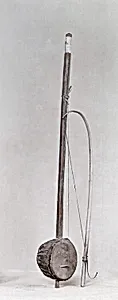
Medium
Coconut shell, wood, rattan, cane
Dimensions
Instrument: 73cm x 12cm x 9cm Bow: 40.6 cm (16 in.); (L.C. says, "L. 2 ft. 4-1/2 in., D. 4-1/2 in., Bow 16-1/2 in.)
Classification
Chordophone
Culture
Bornean
Department
Musical Instruments
Museum
Metropolitan Museum of Art, New York, NY
Credit
The Crosby Brown Collection of Musical Instruments, 1889
Accession Number
89.4.815a, b
Rights
Public Domain
Art Historical Context
Nestled in the Metropolitan Museum of Art's Crosby Brown Collection of Musical Instruments, acquired in 1889, the *Eusrunai* is a captivating chordophone from late 19th-century Borneo. Crafted by an unknown artist from the Bornean culture, this bowed string instrument measures 73 cm long, with a slender 12 cm by 9 cm body and a 40.6 cm bow. Its construction highlights ingenious use of local tropical materials: a coconut shell resonator for the body, paired with wood, rattan, and cane for structural elements, reflecting the resourcefulness of Bornean artisans in harmony with their rainforest environment. As a chordophone—likely producing resonant tones through vibrating strings stretched over a bridge—this instrument offers a window into Borneo's rich musical traditions. Such pieces were integral to communal rituals, storytelling, and celebrations among indigenous groups, where sound evoked spiritual connections to nature. The coconut shell's natural acoustics would amplify warm, earthy vibrations, blending seamlessly with gongs or voices in ensemble performances. Today, the *Eusrunai* stands as a testament to vanishing craftsmanship, preserved amid the Met's vast holdings. Its modest dimensions belie a profound cultural portability, inviting visitors to imagine it echoing through Borneo's misty highlands over a century ago. (198 words)