
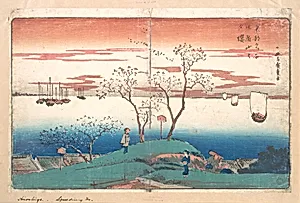
東都名所 御殿山之夕桜|Evening Cherries on Gotem Yama
Medium
Woodblock print; ink and color on paper
Dimensions
9 x 13 15/16 in. (22.9 x 35.4 cm)
Classification
Prints
Culture & Period
Japan · Edo period (1615–1868)
Department
Asian Art
Museum
Metropolitan Museum of Art, New York, NY
Credit
Rogers Fund, 1914
Accession Number
JP30
Rights
Public Domain
Tags
Art Historical Context
**Evening Cherries on Goten Yama** (1830) by Utagawa Hiroige captures a serene twilight moment at Goten Yama, a celebrated hill in Edo (modern Tokyo). This woodblock print, part of Hiroshige's series *amous Places of the Eastern*, depicts blooming cherry trees framing a tranquil riverside scene with boats gliding below. The intimate dimensions—9 x 13 15/16 inches— viewers into the fleeting beauty of spring sakura under a soft evening sky, evoking the Japanese appreciation for *mono no aware*, the pathos of transience. Hiroshige, a master of the ukiyo-e ("pictures of the floating world") movement during Japan's Edo period (1615–1868), revolutionized landscape prints with his atmospheric effects and subtle color gradations. Produced through collaborative woodblock printing—carving by artisans, hand-coloring in layers of ink and pigment—this affordable medium democratized art, allowing commoners to own vivid depictions of famous sites. His innovative use of perspective and light set him apart from contemporaries like Hokusai. Culturally, cherry blossoms symbolize life's impermanence, drawing Edo residents to hanami picnics at spots like Goten Yama. Acquired via the Rogers Fund in 1914, this print at the Metropolitan Museum of Art exemplifies Hiroshige's enduring influence on global art, from Impressionism to modern design. A poetic glimpse into urban Japan's natural splendor! (198 words)
About the Artist
Utagawa Hiroshige · 1826–1869
Utagawa Hiroshige (1797–1858), born Andō Tokutarō, was the last great master of Japanese ukiyo-e woodblock printmaking and one of the most influential landscape artists in history. Born in Edo (modern Tokyo) into a low-ranking samurai family serving as fire wardens, Hiroshige transformed landscape printmaking into a poetic meditation on nature, weather, and everyday life. His revolutionary approac...