
Evening dress
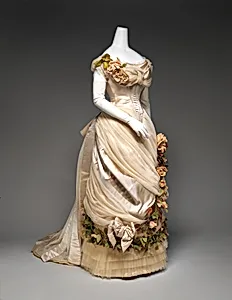
Medium
silk
Classification
Evening dress
Culture
French
Department
Costume Institute
Museum
Metropolitan Museum of Art, New York, NY
Credit
Brooklyn Museum Costume Collection at The Metropolitan Museum of Art, Gift of the Brooklyn Museum, 2009; Gift of the Princess Viggo in accordance with the wishes of the Misses Hewitt, 1931
Accession Number
2009.300.635a, b
Rights
Public Domain
Art Historical Context
In the 1880s, an evening dress from the House of Worth marked its wearer as part of an international circle that moved between Paris, London, and New York ballrooms. Charles Frederick Worth, who had opened his establishment two decades earlier, treated clothing as a seasonal product rather than a one-off commission, supplying ready-to-adapt designs in the finest silks to clients who expected both novelty and continuity with court traditions. The silk is arranged so that its sheen shifts from matte to luminous across the torso and hips, while the floral additions appear to interrupt rather than simply adorn the surface. This produces a tension between the dress’s rigid, corseted structure and the softer, almost botanical movement suggested by the scattered blooms and trailing lengths of fabric. Now in the Costume Institute at The Metropolitan Museum of Art, the dress dates to about 1882. Look closely at the single satin bow set against the hem ruffles, where the silk has been allowed to crease naturally beneath the applied flowers; the small irregularity reveals how the material was coaxed into place rather than forced into perfect symmetry.