
Ewer
Unknown Artist
1825–50
Medium
Free-blown green glass
Dimensions
H. 6 3/4 in. (17.1 cm)
Classification
Ewer
Culture
American
Department
The American Wing
Museum
Metropolitan Museum of Art, New York, NY
Credit
Rogers Fund, 1940
Accession Number
40.41
Rights
Public Domain
Art Historical Context
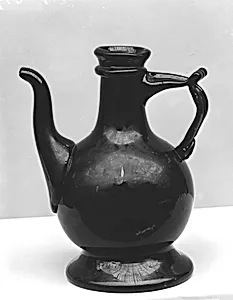
This elegant ewer, crafted between 1825 and 1850, exemplifies early 19th-century American glassmaking at its finest. Standing at 6 3/4 inches tall, it was created using the free-blown technique, where skilled artisans gathered molten glass on a blowpipe and shaped it through careful blowing, swinging, and tool manipulation—without molds. The resulting green glass hue, likely from natural impurities in the batch, gives it a soft, jewel-like translucency that catches the light beautifully, evoking the organic forms of nature. In the context of antebellum America, such ewers were essential household items, used for serving water, wine, or toiletries in middle-class homes. They reflect the burgeoning glass industry in regions like New England and the Midwest, where factories produced affordable yet refined decorative wares amid rapid industrialization. This piece's simple, baluster-shaped form with a flared foot and scrolled handle showcases the artisan's mastery of fluid lines and symmetry, blending utility with understated elegance. Housed in The Metropolitan Museum of Art's American Wing and acquired through the Rogers Fund in 1940, the ewer highlights everyday American craftsmanship. Its anonymous creation underscores the collaborative, workshop-based artistry of the era, preserving a slice of domestic life for modern visitors to appreciate.