
Ewer
Unknown Artist
1830–70
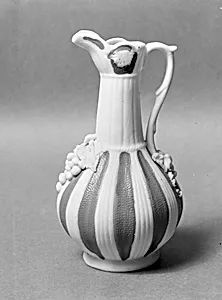
Medium
Parian porcelain
Dimensions
H. 5 7/8 in. (14.9 cm); Diam. 3 1/4 in. (8.3 cm)
Classification
Ewer
Culture
American
Department
The American Wing
Museum
Metropolitan Museum of Art, New York, NY
Credit
Gift of Dr. Charles W. Green, 1947
Accession Number
47.90.177
Rights
Public Domain
Art Historical Context
Step into the refined world of 19th-century American decorative arts this elegant ewer, crafted from Parian porcelain between 1830 and 1870. Standing at just 5⅞ inches tall with a 3¼-inch diameter, this petite pitcher exemplifies the delicate, neoclassical-inspired objects that graced middle-class homes. Parian porcelain, an unglazed "biscuit" ware resembling smooth Parian marble from the Greek island of Paros, was a prized American innovation. Factories like those in Bennington, Vermont, and Trenton, New Jersey, perfected it to create affordable yet sophisticated alternatives to marble sculpture. Historically, this ewer reflects America's growing industrial prowess and cultural aspirations during the antebellum and post-Civil War eras. As the nation expanded, potters drew from European models—think Wedgwood and Meissen—to produce items blending utility and beauty. Ewers like this one served both practical purposes, such as holding water or toiletries, and as display pieces, symbolizing refined taste amid rapid urbanization. A generous gift to the Metropolitan Museum of Art from Dr. Charles W. Green in 1947, this anonymous masterpiece highlights the anonymous artisans who fueled America's decorative arts boom. Though its maker remains unknown, its pristine form invites us to appreciate the era's blend of craftsmanship and elegance. (198 words)