
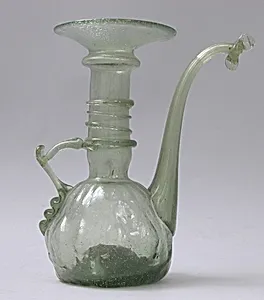
Ewer
Unknown Artist
probably 18th–19th century
Medium
Glass; mold blown and applied decoration, tooled on the pontil
Dimensions
H. 6 5/8 in. (16.8 cm) Max. W. (including spout) 5 1/2 in. (14 cm) Max. Diam. 3 3/8 in. (8.6 cm)
Classification
Glass
Department
Islamic Art
Museum
Metropolitan Museum of Art, New York, NY
Credit
Gift of Henry G. Marquand, 1883
Accession Number
83.7.238
Rights
Public Domain
Art Historical Context
This elegant glass ewer, likely crafted in the 18th or 19th century, the refined artistry of Islamic glassmaking. Standing just 6⅝ inches tall, it served as a practical vessel for pouring water—essential for ritual ablutions in Islamic culture or for serving beverages in daily life. Housed in the Metropolitan Museum of Art's Islamic Art department it was a generous gift from Henry G Marquand in 188, highlighting early Western appreciation for Eastern craftsmanship. The ewers's creation showcases sophisticated techniques: mold-blown glass formed its body, capturing intricate patterns from the mold for a textured, decorative surface. Applied elements were added while molten, then tooled and finished on the pontil—a rod used by glassblowers—creating a smooth base and precise spout. These methods, common in Islamic workshops from the Middle East and beyond, transformed humble glass into objects of beauty, blending utility with subtle luxury. Though the artist remains unknown, this ewer reflects the enduring Islamic tradition of accessible yet masterful glasswork, where everyday items became subtle expressions of skill and faith. Visitors can marvel at its delicate proportions—5½ inches wide with spout—and imagine it gracing a 19th-century home.