
Ewer
Unknown Artist
probably 18th–19th century
Medium
Glass; painted
Dimensions
H. 9 5/16 in. (23.7 cm) W. 4 7/16 in. (11.3 cm) Diam. 4 in. (10.2 cm) Wt. .9905 lbs. (0.449283 kg)
Classification
Glass
Department
Islamic Art
Museum
Metropolitan Museum of Art, New York, NY
Credit
Edward C. Moore Collection, Bequest of Edward C. Moore, 1891
Accession Number
91.1.1553
Rights
Public Domain
Art Historical Context
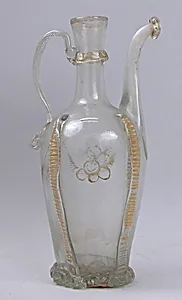
This elegant ewer, crafted from painted glass in the 18 or 19th century, exemplifies the refined artistry of Islamic decorative objects. Standing just over 9 inches tall with graceful spout and modest 4-inch diameter base, it was likely designed for pouring liquids such as water, rosewater, or perfumes during daily rituals or hospitality rites—common in Ottoman, Persian, or North African households of the period. The painted surface would have featured vibrant enamels or gilding, a technique where pigments were applied over the glass and fired at low temperatures to create durable, luminous designs, blending functionality with aesthetic splendor. In the broader context of Islamic art, such vessels highlight the mastery of glassmaking traditions that flourished across the Islamic world from medieval times onward. Unlike earlier trailed or blown glass, painted glass allowed artisans to incorporate intricate motifs without compromising the material's transparency and delicacy. This ewer's survival speaks to the enduring appeal of these objects, which bridged utility and luxury. Acquired through the Edward C. Moore Collection and bequeathed to the Metropolitan Museum of Art in 1891, it invites visitors to appreciate the subtle elegance of anonymous craftsmanship, a hallmark of Islamic decorative arts where the object's harmony often outshines the maker's name.