
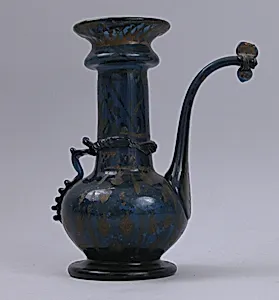
Ewer
Unknown Artist
probably 18th–19th century
Medium
Glass; molded
Dimensions
H. 6 5/8 in. (16.8 cm) Max. W. 5 1/2 in. (14 cm) Max. Diam. 3 5/16 in. (8.4 cm) Wt. 7.808 oz. (221.357 g)
Classification
Glass
Department
Islamic Art
Museum
Metropolitan Museum of Art, New York, NY
Credit
Edward C. Moore Collection, Bequest of Edward C. Moore, 1891
Accession Number
91.1.2061
Rights
Public Domain
Art Historical Context
This elegant glass ewer, likely crafted in the 18th or 19th century, the refined artistry of Islamic glassmaking. Standing just 6⅝ inches tall with a maximum width of ½ inches, its compact form made it ideal for pouring water or other liquids in domestic or ritual settings. The molded glass technique—pressing molten glass into a mold—allowed artisans to create detailed patterns and shapes efficiently, a method popular in Islamic regions for producing affordable yet beautiful vessels. In the context of Islamic art, ewers like this held both practical and cultural significance. They were essential for ablutions before prayer, serving tea, or rosewater sprinkling during hospitality rituals, reflecting the Islamic emphasis on purity and elegance in everyday life. The translucent quality of molded glass highlighted the material's natural beauty, often enhanced with subtle facets or reliefs that caught the light, showcasing technical skill without ostentation. Acquired through the Edward C. Moore Collection and bequeathed to the Metropolitan Museum of Art in 1891, this piece preserves a window into pre-modern Islamic craftsmanship. Its preservation in the museum's Islamic Art department invites visitors to appreciate how such humble objects embodied sophisticated design traditions across the Middle East and beyond.