
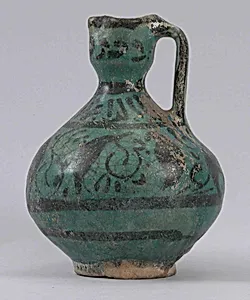
Ewer
Unknown Artist
12th–13th century
Medium
Stonepaste; underglaze painted
Dimensions
H. 5 3/8 in. (13.7 cm) Max. Diam. 4 1/16 in. (10.3 cm)
Classification
Ceramics
Department
Islamic Art
Museum
Metropolitan Museum of Art, New York, NY
Credit
Rogers Fund, 1908
Accession Number
08.110.10
Rights
Public Domain
Art Historical Context
This delicate stonepaste ewer, crafted by an unknown artist in the th–13th century exemplifies the pinnacle of Islamic ceramic artistry during the medieval Islamic world, likely from regions like Persia or Syria. Standing just 5⅜ inches tall with a maximum diameter of inches, its petite scale suggests it was a luxury item, perhaps used for pouring scented waters during ablutions, social rituals, or at the table—reflecting the refined domestic culture of the era under Seljuk or Abbasid influence. The medium of stonepaste, or fritware, was a groundbreaking Islamic innovation: a composite of quartz, clay, and glass frit fired to create a white, porcelain-like body that true porcelain technology couldn't yet replicate outside China. Underglaze painting further enhanced its durability and vibrancy; pigments were applied beneath a transparent glaze before firing, ensuring motifs withstood daily use while showcasing intricate designs, often floral or geometric patterns emblematic of Islamic aniconism and aesthetic harmony. Acquired through the Rogers Fund in 1908 and housed in the Metropolitan Museum of Art's Islamic Art Department, this ewer highlights the technical ingenuity that positioned Islamic ceramics as a global influence, bridging East and West in the arts of utility and beauty.