
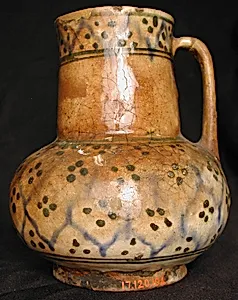
Ewer
Unknown Artist
18th century
Medium
Stonepaste; underglaze painted
Dimensions
Ht. 5 7/8 in. (14.9 cm) W. 4 13/16 in. (12.3 cm)
Classification
Ceramics
Department
Islamic Art
Museum
Metropolitan Museum of Art, New York, NY
Credit
Mr. and Mrs. Isaac D. Fletcher Collection, Bequest of Isaac D. Fletcher, 1917
Accession Number
17.120.104
Rights
Public Domain
Art Historical Context
This elegant 18th-century e, crafted from stonepaste with underglaze painting, the refined ceramic traditions of the Islamic world. just under 6 inches tall and 5 inches wide, this small yet graceful pitcher—likely used for pouring water, rosewater, ablutions—was both a functional household item and a canvas for artistic expression. Stonepaste, a composite of quartz, clay, and frit, was a ingenious Islamic innovation from the medieval period, allowing artisans to create porcelain-like translucency and durability without access to true kaolin clay. The underglaze technique, where pigments are applied directly to the unfired body before a transparent glaze is added and the piece is fired, ensured vibrant, long-lasting colors resistant to wear. This method, perfected in regions like Persia and the Ottoman Empire, highlights the technical mastery of anonymous workshops, where potters balanced utility with aesthetic beauty through geometric patterns, floral motifs, or calligraphy—hallmarks of Islamic design that evoke harmony and. Housed in the Metropolitan Museum of Art's Islamic Art Department as part of the D. Fletcher Bequest, this ewer invites us to appreciate the everyday artistry of 18th-century Islamic culture, bridging domestic life and cultural.