
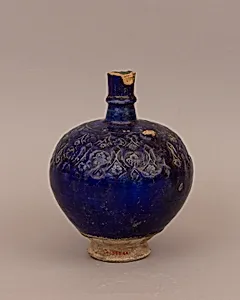
Ewer
Unknown Artist
12th–13th century
Medium
Earthenware; glazed
Dimensions
Ht. 8 in. (20.3 cm) Diam. 5 7/16 in. (13.8 cm)
Classification
Ceramics
Department
Islamic Art
Museum
Metropolitan Museum of Art, New York, NY
Credit
H.O. Havemeyer Collection, Gift of Horace Havemeyer, 1941
Accession Number
41.165.44
Rights
Public Domain
Art Historical Context
This elegant ewer, crafted by an unknown artist in the th–13th century hails from the vibrant world of Islamic. Ewers like this were essential household items, used for pouring water during ablutions or serving beverages in daily life and social rituals. Dating to the medieval Islamic golden age, it reflects the ingenuity of artisans across regions like Persia or the Levant, where ceramics flourished as both functional wares and symbols of refined taste. Made of earthenware coated with a glossy glaze, the vessel showcases early mastery of ceramic techniques that made pottery durable, waterproof, and beautifully decorative. The glaze not only sealed the porous clay but allowed for vibrant colors and intricate patterns—hallmarks of Islamic pottery innovation. Standing just 8 inches tall with a 5⅜-inch diameter, its compact form was perfectly suited for intimate settings, blending utility with artistry. A cherished piece from the H.O. Havemeyer Collection, gifted to the Metropolitan Museum of Art in 1941, this ewer invites us to appreciate the anonymous makers whose skill elevated everyday objects into enduring treasures of cultural heritage.