
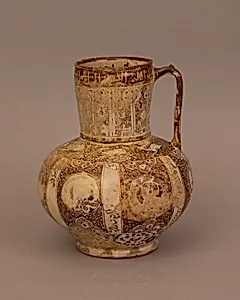
Ewer
Unknown Artist
13th century
Medium
Stonepaste; glazed, luster-painted and incised
Dimensions
H. 8 in. (20.3 cm)
Classification
Ceramics
Department
Islamic Art
Museum
Metropolitan Museum of Art, New York, NY
Credit
H.O. Havemeyer Collection, Gift of Horace Havemeyer, 1948
Accession Number
48.113.24
Rights
Public Domain
Art Historical Context
This exquisite 13th-century e, crafted by an unknown artist, exemplifies the pinnacle of Islamic ceramic artistry from the medieval Islamic world. Standing at just 8 inches (20.3 cm) tall, this vessel—likely used for pouring water or rosewater in ablutions or at table—blends everyday utility with opulent decoration. Housed in the Metropolitan Museum of Art's Islamic Department as part of the renowned H.O. Havemeyer Collection (gifted in 1948), it the cultural sophistication of regions like Syria or Iran during a golden age of craftsmanship, even amid the era's political upheavals. The ewers's medium, stonepaste (also known as fritware), was a revolutionary Islamic innovation from the 10th century onward. This quartz-based body allowed for thin walls and translucency, mimicking Chinese porcelain while enabling bold experimentation. It's masterfully glazed for a glossy sheen, luster-painted with metallic gold and ruby hues that shimmer like jewelry under light—a technique perfected in the Abbasid and later Ayyubid eras—and intricately incised to create textured motifs, possibly floral or geometric patterns evoking paradise gardens. These methods not only highlighted technical virtuosity but also symbolized luxury and piety in Islamic society. For visitors, this ewer invites a closer look at how artisans transformed humble clay into treasures, bridging function and fine art across centuries.