
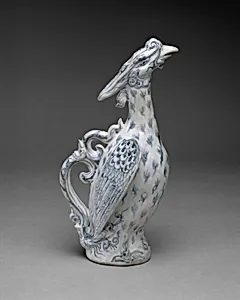
Ewer in the Form of a Phoenix
Unknown Artist
ca. 15th–16th century
Medium
Stoneware with underglaze cobalt blue decoration
Dimensions
H. 11 1/2 in. (29.2 cm)
Classification
Ceramics
Culture
Vietnam
Department
Asian Art
Museum
Metropolitan Museum of Art, New York, NY
Credit
Gift of Betty and John R. Menke, 1992
Accession Number
1992.72.1
Rights
Public Domain
Tags
Art Historical Context
This elegant ewer, crafted in Vietnam during the 15th or 16th century, showcases the refined ceramic traditions of the region. Standing just over eleven inches tall, the stoneware vessel takes the graceful form of a phoenix—a mythical bird long associated with renewal, virtue, and imperial favor in East and Southeast Asian cultures. Its smooth contours and poised stance transform a practical pouring vessel into a sculptural object of quiet beauty. Vietnamese potters achieved the striking cobalt-blue decoration by painting directly onto the clay before applying a clear glaze, a technique that allowed the vivid color to fuse permanently during firing. While inspired by Chinese blue-and-white wares, Vietnamese examples often feature more fluid, naturalistic modeling, as seen in the phoenix’s elegantly curved neck and subtly incised feathers. Such ewers were likely used in both domestic and ceremonial settings, reflecting the high regard for ceramics in Vietnamese society. Today, this piece in the Metropolitan Museum’s collection reminds visitors of Vietnam’s distinctive contribution to Asian ceramic art, where technical mastery and symbolic imagery combined to create objects that were both functional and profoundly meaningful.