
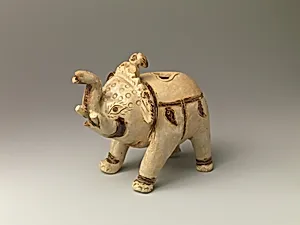
Ewer in the Form of an Elephant
Unknown Artist
11th–12th century
Medium
Glazed pottery with incised and inlaid decoration
Dimensions
H. 4 3/4 in. (12.1 cm); W. 3 1/8 in. (7.9 cm); L. 5 3/8 in. (13.7 cm)
Classification
Ceramics
Culture & Period
Vietnam · Ly dynasty (1009–1225)
Department
Asian Art
Museum
Metropolitan Museum of Art, New York, NY
Credit
Purchase, The Vincent Astor Foundation Gift, 2007
Accession Number
2007.261
Rights
Public Domain
Tags
Art Historical Context
Behold the charming *Ewer in the Form of an Elephant*, a pottery vessel from Vietnam's Ly dynasty (10091225). Crafted an unknown artist in the11th–12th, this petite ewer—standing just 4 3/4 inches tall—captures the majestic form of an elephant, a creature revered in Southeast Asian culture as a symbol of strength, royalty, and good fortune. During the Ly period, Vietnam enjoyed a golden age of independence following centuries of Chinese rule, fostering vibrant artistic expression in ceramics. The ewers's medium showcases sophisticated techniques: a glossy glaze enhances its luster, while incised lines and inlaid decorations—likely with materials like slip or metal oxides—define the elephant's features, trunk, and tusks with remarkable detail. These methods reflect the era's mastery of high-fired stoneware, influenced by regional trade along maritime silk routes, blending local ingenuity with broader Asian ceramic traditions. Housed in the Metropolitan Museum of Art's Asian Art Department (purchase from The Vincent Astor Foundation Gift, 2007), this ewer not only served practical purposes like pouring water or rice wine but also embodied the Ly court's appreciation for whimsical, zoomorphic designs. Imagine it gracing a noble's table, evoking the thunder of royal elephants in procession—a delightful window into Vietnam's artistic heritage.