
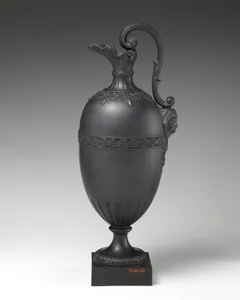
Ewer (one of a pair)
possibly 1778–92
Medium
Black basalt (stoneware)
Dimensions
Height (each): 11 1/8 in. (28.3 cm)
Classification
Ceramics-Pottery
Culture
British, Staffordshire
Department
European Sculpture and Decorative Arts
Museum
Metropolitan Museum of Art, New York, NY
Credit
The Friedsam Collection, Bequest of Michael Friedsam, 1931
Accession Number
32.100.354
Rights
Public Domain
Art Historical Context
This elegant pair of ewers from Church Works exemplifies the pinnacle of 18th-century British from Staffordshire, a region synonymous with innovative pottery during the Industrial Revolution. Crafted possibly between 1778 and 1792, each ewer stands 11⅛ inches tall and is made of black basalt stoneware—a dense, unglazed material prized for its smooth, matte black finish that evoked the somber elegance of ancient Greek and Roman vases. This neoclassical revival was hugely popular among the British elite, blending functionality as a pitcher with sophisticated decorative appeal for dining tables or sideboards. The artistic technique behind black basalt involved refining clay with basalt rock for a stone-like durability and high-fired vitrification, achieving a non-porous surface without glaze. Church Works, a Staffordshire factory, contributed to this vibrant industry by producing such refined objects that democratized classical luxury. These ewers highlight how potters mastered mass production while maintaining form, often adorned with subtle fluting or anthemion motifs inspired by antiquity. Now part of The Friedsam Collection at The Metropolitan Museum of Art, these pieces invite us to appreciate Staffordshire's role in shaping global decorative arts, bridging ancient ideals with Enlightenment-era craftsmanship.