
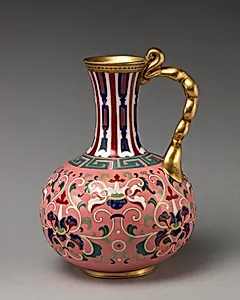
Ewer with "cloisonné" decoration
1873
Medium
Bone china with enamel decoration and gilding
Dimensions
confirmed: 8 11/16 × 6 1/4 × 6 3/8 in., 1.7 lb. (22.1 × 15.9 × 16.2 cm, 750g)
Classification
Ceramics-Porcelain
Culture
British, Stoke-on-Trent, Staffordshire
Department
European Sculpture and Decorative Arts
Museum
Metropolitan Museum of Art, New York, NY
Credit
Gift of Helene Fortunoff and Robert Grossman, 2017
Accession Number
2018.62.33
Rights
Public Domain
Art Historical Context
This elegant ewer, crafted by the renowned Minton firm in Stoke-on-Trent Staffordshire, in 1873, exemplifies the of Victorian British ceramics. Made from fine bone china—a durable, translucent porcelain developed in England in the late 18th century—the features intricate "cloisonné" decoration achieved through enamel and gilding. Standing at just over 8 inches tall, its graceful form and ornate surface made it both a functional water pitcher and a luxurious table ornament for affluent Victorian homes. Minton, a leader in the Staffordshire pottery industry, pioneered innovative techniques during the 19th century, blending industrial precision with artistic flair. The "cloisonné" effect mimics the ancient Japanese and Chinese enamel-on-metal method, where metal wires create compartments filled with colored enamels. Here, skilled artisans applied enamel paints and gold leaf to evoke that opulent look on porcelain, reflecting the era's Aesthetic Movement fascination with Eastern motifs and historicism. This hybrid approach showcased Minton's technical virtuosity amid the competitive Great Exhibition culture of the 1850s–1870s. Housed in The Metropolitan Museum of Art's European Sculpture and Decorative Arts collection, this gift from Helene Fortunoff and Robert Grossman highlights the enduring appeal of British design. It invites visitors to appreciate how everyday objects became canvases for global artistic dialogue, bridging functionality and fine art in the industrial age.
About the Artist
Minton(s) · 1793–2001
Minton is among the most distinguished names in the history of British ceramics, a firm whose two and a quarter centuries of production encompass everything from blue transfer-printed earthenwares to the most rarefied decorative porcelain of the Victorian age. The company was founded in 1793 by Thomas Minton (1765–1836) in Stoke-upon-Trent, Staffordshire — the heart of England's pottery industry. ...