
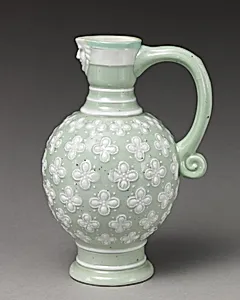
Ewer with quatrefoil motifs
1870
Medium
Glazed Parian ware
Dimensions
confirmed: 7 × 4 3/4 × 4 in. (17.8 × 12.1 × 10.2 cm)
Classification
Ceramics-Porcelain
Culture
British, Stoke-on-Trent, Staffordshire
Department
European Sculpture and Decorative Arts
Museum
Metropolitan Museum of Art, New York, NY
Credit
Gift of Helene Fortunoff and Robert Grossman, 2017
Accession Number
2018.62.38
Rights
Public Domain
Art Historical Context
### Ewer with Quatrefoil Motifs Crafted in 1870 by the esteemed British firm Minton(s) in Stoke-on-Tr, Staffordshire—the epicenter of Victorian ceramics—this elegant ewer exemplifies the height of 19th-century decorative arts Standing at just 7 inches tall, its compact form (7 × 4¾ × 4 in.) belies its refined presence, designed as a functional yet ornamental pitcher for serving water or as a lavish table accent. The quatrefoil motifs—interlaced four-lobed designs inspired by Gothic architecture—adorn its surface, evoking medieval elegance revived during the Victorian era's fascination with historicism. Made of glazed Parian ware, a fine porcelain prized for its creamy, marble-like translucency, this piece showcases Minton's mastery of advanced ceramic techniques. Parian ware, developed in the 1840s, allowed for sculptural detail without the fragility of true marble, making it ideal for both utilitarian objects and virtuoso figurines. The glazing adds a subtle sheen, enhancing its jewel-like quality while protecting the delicate body. Produced amid Britain's Industrial Revolution, such wares highlighted the fusion of mass production and artistry, appealing to a growing middle class eager for affordable luxury. Housed in the Metropolitan Museum of Art's European Sculpture and Decorative Arts collection (gift of Helene Fortunoff and Robert Grossman, 2017), this ewer captures the cultural zeitgeist of Victorian refinement, blending utility with intricate ornamentation for homes that aspired to grandeur. A testament to Stoke-on-Trent's pottery legacy, it invites visitors to appreciate the tactile beauty of British porcelain innovation.
About the Artist
Minton(s) · 1793–2001
Minton is among the most distinguished names in the history of British ceramics, a firm whose two and a quarter centuries of production encompass everything from blue transfer-printed earthenwares to the most rarefied decorative porcelain of the Victorian age. The company was founded in 1793 by Thomas Minton (1765–1836) in Stoke-upon-Trent, Staffordshire — the heart of England's pottery industry. ...