
Ewer with 'Tughra-Illuminator' Style Decoration
Unknown Artist
1525–40
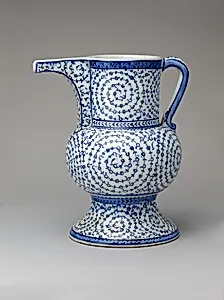
Medium
Stonepaste; painted in blue under transparent glaze
Dimensions
Pitcher (a): H. 8 13/16 in. (22.4 cm) W. 7 7/16 in. (18.9 cm) Max. diam. 5 1/2 in. (14 cm) Lid (b): H. 1 9/16 in. (4 cm) Diam. 3 7/16 in. (8.7 cm) Wt. 1.9 oz (53.9 g)
Classification
Ceramics
Department
Islamic Art
Museum
Metropolitan Museum of Art, New York, NY
Credit
Harris Brisbane Dick Fund, 1966
Accession Number
66.4.3a, b
Rights
Public Domain
Art Historical Context
This exquisite ewer, crafted between 1525 and 1540, exemplifies the pinnacle of Ottoman Islamic ceramics during the empire's golden age under Suleiman the Magnificent. Made of stonepaste—a fine, vitreous clay body prized for its ability to mimic Chinese porcelain—the pitcher and its fitted lid feature intricate blue paintings under a transparent glaze. Standing about 9 inches tall with the lid, it was likely used for pouring rosewater or other scented liquids in elite households or ceremonies, blending utility with opulent artistry. The decoration in the 'Tughra-Illuminator' style draws directly from Ottoman manuscript traditions, where the tughra—the sultan's elaborate calligraphic monogram—served as a symbol of imperial authority. Here, artists adapted this illuminator's flourish to ceramics, creating swirling floral motifs and geometric patterns in vibrant cobalt blue against a white ground. This technique, perfected in workshops like those in Iznik, Turkey, highlights the cross-pollination of calligraphy, painting, and pottery in Islamic art, turning everyday objects into imperial statements. Today, this ewer graces the Metropolitan Museum of Art's Islamic Art collection, acquired through the Harris Brisbane Dick Fund in 1966. It invites us to appreciate how 16th-century artisans transformed clay into a canvas for power, beauty, and cultural prestige.