
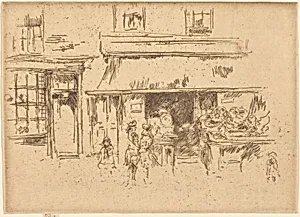
Exeter Street
c. 1886/1888
Medium
etching on laid paper
Dimensions
overall (trimmed to plate): 12.7 × 17.7 cm (5 × 6 15/16 in.)
Classification
Department
CG-W
Museum
National Gallery of Art, Washington, D.C.
Credit
Rosenwald Collection
Accession Number
1943.3.8586
Rights
Public Domain
Art Historical Context
James McNeill Whistler, the renowned American-born artist active in Victorian London, captures the quiet essence of urban life in *Exeter Street*, an etching created around 1886–1888. Best known for his "art for art's sake" philosophy and tonal harmonies, Whistler produced this intimate street scene during a prolific period of printmaking, following his celebrated Venice and Thames series. The work reflects his fascination with everyday London neighborhoods, evoking a sense of atmospheric mystery amid the city's bustle. Etched on laid paper—a traditional support prized for its subtle texture that enhances ink retention—*Exeter Street* showcases Whistler's masterful intaglio technique. Using fine lines and soft grounds, he achieved delicate gradations of tone, prioritizing mood over narrative detail, much like his famous nocturnes in oil. Trimmed to its plate edges at 12.7 × 17.7 cm, the print's compact scale invites close contemplation, a hallmark of his innovative approach to etching as fine art rather than mere reproduction. Housed in the National Gallery of Art's Rosenwald Collection, this piece underscores Whistler's enduring influence on modern printmaking, bridging 19th-century realism with impressionistic subtlety. Visitors will appreciate how it transports us to foggy Exeter Street, whispering of a bygone era's subtle beauty.
About the Artist
James McNeill Whistler · 1834–1903
James Abbott McNeill Whistler (1834-1903) was an American-born painter and printmaker who became a leading figure in the Aesthetic Movement and pioneer of Tonalism and Japonisme. He revolutionized art by championing "art for art's sake" and treating paintings as visual equivalents of musical compositions, titling works as "arrangements," "harmonies," and "nocturnes" to emphasize formal qualities o...