
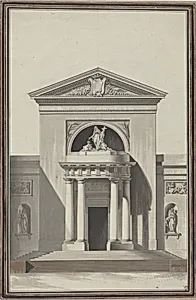
Facade for a Church with a Sculpture Representing Faith
c. 1768
Medium
pen and gray ink with gray and brown washes over black chalk on laid paper
Dimensions
overall: 45.9 x 28.7 cm (18 1/16 x 11 5/16 in.)
Classification
Drawing
Department
CG-E
Museum
National Gallery of Art, Washington, D.C.
Credit
Ailsa Mellon Bruce Fund
Accession Number
1996.73.5
Rights
Public Domain
Art Historical Context
Louis Gustave Taraval’s “Facade for a Church with a Sculpture Representing Faith” offers a glimpse into eighteenth-century architectural imagination. Created around 1768, the drawing presents an elegant church entrance crowned by a prominent allegorical figure of Faith, whose upward gaze and attributes would have welcomed worshippers with a clear message of devotion. Such designs were often prepared for competitions, church renovations, or royal commissions, reflecting the period’s blend of religious purpose and refined aesthetic taste. Executed in pen and gray ink with delicate gray and brown washes over black chalk, the sheet demonstrates Taraval’s mastery of light and shadow. The layered washes give the stone architecture a convincing sense of volume and texture, while the fluid line work captures ornamental details with precision. Working on laid paper, the artist produced a presentation piece that could be easily understood by patrons and builders alike. Today housed in the National Gallery of Art, this drawing preserves a moment when architecture, sculpture, and drawing worked together to shape sacred space. Its modest size belies the grandeur it envisions, inviting viewers to appreciate both the artist’s technical skill and the cultural importance of faith as a public, visible virtue.
About the Artist
Louis Gustave Taraval · 1738–1794
Taraval served as inspector for the Bâtiments du Roi. According to Macmillan, he was influential in the publication of several important architects, including Pierre Contant D'Ivry and Jean François Chalgrin.