
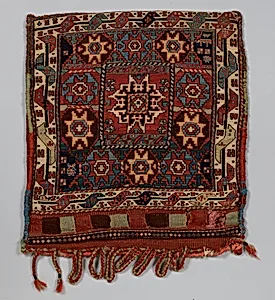
Face from Half of Double Saddle Bag (Khorjin)
Unknown Artist
19th century
Medium
Wool; sumak brocaded, tapestry weave
Dimensions
H. 22 in. (55.9 cm) W. 20 in. (50.8 cm)
Classification
Textiles-Woven-Brocade
Department
Islamic Art
Museum
Metropolitan Museum of Art, New York, NY
Credit
Gift of Inger G. and William B. Ginsberg, 2015
Accession Number
2015.490.14
Rights
Public Domain
Art Historical Context
This striking fragment, titled *Face from Half of Double Bag (Khorjin)*, hails from 19th-century Islamic art traditions, likely crafted by nomadic weavers in Central Asia or Caucasus. Measuring 22 by 20 inches, it forms part of a practical yet beautifully adorned khorjin—a double saddle bag used by horseback travelers to carry goods securely. Donated to the Metropolitan Museum of Art 2015 by Inger G. and William B. Ginsberg, this wool textile showcases the ingenuity of anonymous artisans who transformed everyday objects into cultural treasures. Woven in a sumak brocaded tapestry technique, the piece features a bold, stylized face motif—a common protective symbol in nomadic textiles, possibly evoking ancestors or spiritual guardians. Sumak weaving, where colored weft threads are wrapped tightly around warps to create a sculptural, reversible brocade, ensured durability for the rigors of travel while allowing vibrant patterns to endure. This method, distinct from knotted pile rugs, highlights the technical mastery of these communities. In the broader context of Islamic textiles, such works reflect a blend of utility and artistry, preserving oral histories through abstract designs. Though the artist remains unknown, this khorjin half invites us to appreciate the vibrant legacy of nomadic life, where every stitch told a story of resilience and beauty.