
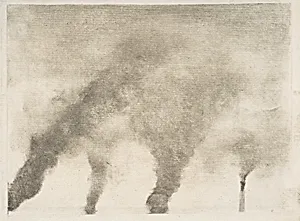
Factory Smoke
1877–79
Medium
Monotype printed in black ink on laid paper
Dimensions
sheet: 5 13/16 x 6 13/16 in. (14.7 x 17.3 cm) plate: 4 11/16 x 6 5/16 in. (11.9 x 16.1 cm)
Classification
Prints
Department
Drawings and Prints
Museum
Metropolitan Museum of Art, New York, NY
Credit
The Elisha Whittelsey Collection, The Elisha Whittelsey Fund, 1982
Accession Number
1982.1025
Rights
Public Domain
Art Historical Context
Created during the height of the Impressionist movement, Edgar Degas’s *Factory Smoke* (1877–79) captures a fleeting moment of industrial life. Though best known for his ballet scenes and portraits, Degas often turned his attention to the rapidly changing urban and industrial landscape of late-nineteenth-century France. The delicate veil of smoke rising from factory chimneys offered him a perfect subject for exploring atmosphere, movement, and the effects of light—concerns central to Impressionism. This small monotype, printed in rich black ink on laid paper, showcases Degas’s innovative printmaking experiments of the period. Unlike traditional etching or lithography, the monotype technique allowed the artist to work directly on a smooth plate, producing a single, velvety impression with soft, painterly tones. The result is an intimate, almost sketch-like image that emphasizes the ephemeral quality of smoke drifting through the air. Acquired by the Metropolitan Museum of Art in 1982, the work highlights Degas’s fascination with modern industry and his willingness to push boundaries beyond the canvas. Its modest size invites close viewing, rewarding visitors with a quiet yet powerful glimpse of the era’s transformation.
About the Artist
Edgar Degas · 1834–1917
Edgar Degas (1834-1917) stands as one of the most innovative artists of the nineteenth century, whose distinctive vision transformed how modern life could be depicted on canvas. Born Hilaire-Germain-Edgar De Gas in Paris to a wealthy banking family—his father French, his mother a Louisiana Creole from New Orleans—Degas received a classical education before abandoning law studies in 1855 to pursue ...