
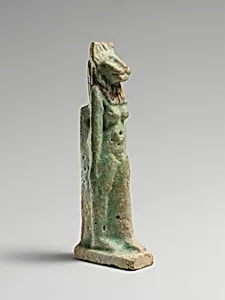
Faience amulet in the form of a lion-headed deity
Unknown Artist
664–30 BCE
Medium
Clay, glazed
Dimensions
H.: 2 7/8 in. (7.3 cm)
Classification
Gold and Silver
Culture & Period
Egyptian · Late Dynastic–Hellenistic
Department
Greek and Roman Art
Museum
Metropolitan Museum of Art, New York, NY
Credit
The Cesnola Collection, Purchased by subscription, 1874–76
Accession Number
74.51.4492
Rights
Public Domain
Tags
Art Historical Context
This enchanting faience amulet depicts a lion-headed deity, Sekhmet, the Egyptian goddess of war, healing, and protection.ed from glazed clay during Egypt's Late Dynastic to Hellenistic periods (664–30 BCE), it stands just 2 7/8 inches tall, small enough to wear as a protective talisman. Faience, with its vibrant turquoise glaze mimicking precious lapis lazuli, was a favored medium for amulets, symbolizing eternity and divine power in ancient Egyptian belief. Sekhmet's lioness embodied both destruction and restoration, reflecting the dual nature of the cosmos. Worn or placed in tombs, such amulets safeguarded the owner from harm, invoking the goddess's might against enemies and illness. This piece, part of The Cesnola Collection at the Metropolitan Museum of Art, highlights the enduring Egyptian influence during the Hellenistic era, when Ptolemaic rulers blended local traditions with Greek elements. The meticulous glazing technique—fusing crushed quartz with colorants—created a luminous, enduring surface, showcasing Egyptian artisans' mastery of low-fired ceramics. A testament to everyday spirituality, it invites us to ponder the ancient Egyptians' quest for divine safeguarding in an unpredictable world.