
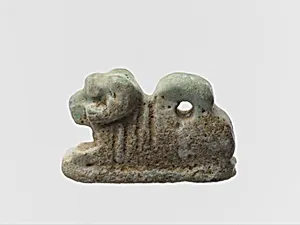
Faience amulet in the form of a ram
Unknown Artist
664–30 BCE
Medium
Clay, glazed
Dimensions
H.: 11/16 in. (1.7 cm)
Classification
Gold and Silver
Culture & Period
Egyptian · Late Dynastic–Hellenistic
Department
Greek and Roman Art
Museum
Metropolitan Museum of Art, New York, NY
Credit
The Cesnola Collection, Purchased by subscription, 1874–76
Accession Number
74.51.4501
Rights
Public Domain
Tags
Art Historical Context
This exquisite faience amulet, shaped as a ram, dates to Egypt's Late Dynastic–Hellenistic period (664–30 BCE). Crafted from glazed clay, it measures a mere 11/16 inch (1.7 cm) in height, making it ideal for personal wear or as a protective talisman. Faience—a composite of quartz paste fired with a brilliant glaze—was a hallmark Egyptian medium, prized for its vibrant blue-green sheen that evoked the afterlife's eternal waters and mimicked semiprecious stones like lapis lazuli. In ancient Egyptian culture, amulets like this ram form served vital apotropaic roles, warding off evil and ensuring safe passage through life and death. The ram motif likely symbolized power, fertility, and renewal, motifs resonant across Egyptian religious art. Its small scale highlights the mastery of miniaturization, where every detail—from curved horns to sturdy stance—was rendered with precision. Acquired through the Cesnola Collection (1874–76), this piece now graces the Metropolitan Museum of Art's Greek and Roman Art department, offering a window into Egypt's enduring artistic legacy amid cultural transitions.