
Fantasy
Pierre Puvis de Chavannes, 1824–98
About this artwork
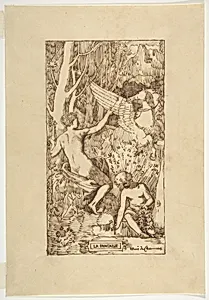
In the hushed galleries of the Metropolitan Museum of's Drawings and Prints department, Pierre Puvis de Chav's *Fantasy* (ca. 1824–98) captivates with its dreamlike vision. This intimate pen and brown ink drawing on calque— a translucent tracing paper, later laid down on wove—measures just 11 13/16 x 8 1/16 inches, close contemplation. Rendered during the artist's mature career, it evokes a mythological reverie featuring male nudes and the winged horse Pegasus, symbols of poetic inspiration and heroic ascent drawn from classical antiquity. Puvis de Chavannes, a leading French Symbolist, bridged Realism and the nascent Art Nouveau with his ethereal style, favoring simplified forms and muted tones to convey spiritual harmony. Active from the mid-19th century, he adorned public spaces with murals celebrating humanity's noble ideals, influencing contemporaries like Gustave Moreau and later modernists such as Picasso. *Fantasy*, likely a preparatory study, exemplifies his fascination with idealized male anatomy and fantastical narratives, reflecting the era's Romantic nostalgia for ancient myths amid industrialization. The use of brown ink on calque highlights Puvis's precise, linear technique, allowing fluid contours and subtle shading that suggest movement and light. Bequeathed by William S. Lieberman in 2005, this delicate work underscores the enduring allure of drawing as a window into an artist's imagination, blending sensuality with sublime aspiration.