
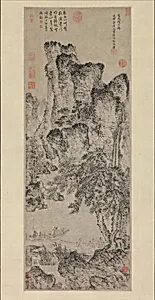
元 趙原 (元) 晴川送客圖 軸|Farewell by a Stream on a Clear Day
second half 14th century
Medium
Hanging scroll; ink on paper
Dimensions
Image: 37 1/2 x 13 7/8 in. (95.3 x 35.2 cm) Overall with mounting: 77 1/4 x 20 1/2 in. (196.2 x 52.1 cm) Overall with knobs: 77 1/4 x 23 3/8 in. (196.2 x 59.4 cm)
Classification
Paintings
Culture & Period
China · Yuan dynasty (1271–1368)
Department
Asian Art
Museum
Metropolitan Museum of Art, New York, NY
Credit
Ex coll.: C. C. Wang Family, Purchase, Gift of J. Pierpont Morgan, by exchange, 1973
Accession Number
1973.121.8
Rights
Public Domain
Tags
About this artwork
Zhao Yuan (active c. 1350-75), a Chinese painter from Suzhou's literary circles during the late Yuan dynasty, created this masterful hanging scroll for his friend Liu Guangwen. Executed in ink on paper measuring 37½ by 13⅞ inches (image), the painting demonstrates Zhao's distinctive style influenced by his contemporary Wang Meng. The artist's inscription reads: "Zhao Yuan of Jucheng painted this Farewell by a Stream on a Clear Day for Tuixuan, Liu Guangwen." The work exemplifies literati paintin...
Art Historical Context
**Farewell by a Stream on a Clear Day**, a hanging scroll in ink on paper by Zhao Yuan (active c. 1350–75), captures a poignant moment from late Yuan dynasty China (1271–1368). Painted for his friend Liu Guangwen, the 37½ × 13⅞-inch image depicts a scholar bidding farewell by a serene stream, framed by misty mountains and a departing boat—a classic literati theme evoking Confucian ideals of friendship, virtue, and the fleeting nature of life. Hailing from Suzhou's vibrant literary circles, Zhao infused the work with the scholarly refinement of the Yuan era, drawing influence from his contemporary Wang Meng. Zhao's mastery shines in his innovative use of dots and varied brushwork, which blend representational precision with abstract beauty. Dots of differing sizes, shapes, and densities masterfully control texture and tonality, elevating the landscape beyond mere description to evoke emotional depth and atmospheric harmony. This exemplifies literati painting's emphasis on personal expression over decorative excess. Tragically, Zhao's promising career ended abruptly when the first Ming emperor, wary of Suzhou's intelligentsia, summoned and executed him in Nanjing. Acquired from the C.C. Wang Collection, this rare survivor at the Metropolitan Museum of Art offers a window into Yuan artistic brilliance on the cusp of dynastic change.