
Farmington
1843
Medium
Watercolor and graphite on off-white wove paper
Dimensions
7 1/4 x 20 1/16 in. (18.4 x 51 cm)
Classification
Watercolor
Culture
American
Department
The American Wing
Museum
Metropolitan Museum of Art, New York, NY
Credit
Rogers Fund, 1973
Accession Number
1973.119
Rights
Public Domain
Tags
Art Historical Context
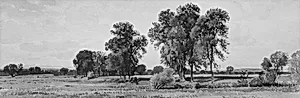
**Farmington** by Samuelman, painted in 1843, captures the serene beauty of the American landscape in a delicate watercolor and graphite composition on off-white wove. Measuring 7 1/4 x 20 1/16 inches, its panoramic format invites viewers into a wide vista likely featuring trees and pastoral scenery, evoking the vast of the 19th countryside. Housed in The Museum of Art's American Wing and acquired through the Rogers Fund in 1973, this work exemplifies early American artistic exploration of. Created during a time when American artists were increasingly turning to their own landscapes for inspiration—away from European traditions—**Farmington** reflects the cultural pride in the nation's burgeoning identity. Colman's use of watercolor, prized for its luminosity and fluidity, allows translucent layers to build atmospheric depth, while graphite underdrawings provide precise contours for trees and terrain. Wove paper's smooth texture supports these fine techniques, making it ideal for detailed studies that blend observation with poetic interpretation. This intimate yet expansive piece offers a window into mid-19th-century America, reminding us how artists like Colman celebrated the everyday wonders of farms and forests, fostering a deeper appreciation for our shared natural heritage.
About the Artist
Samuel Colman · 1832–1920
Colman grew up in New York, where his father ran a successful publishing business. The family bookstore on Broadway, was a popular meeting place for artists and there Colman met Hudson River School painters. American interior designer, New York, N.Y.; associated with L.C. Tiffany. Comment on works: landscape