
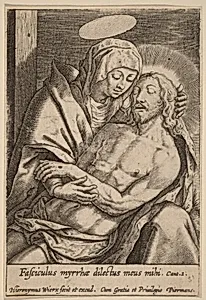
Fasciculus myrrhae dilectus meus mihi
1551 to 1600
Medium
engraving
Classification
Department
CG-E
Museum
National Gallery of Art, Washington, D.C.
Credit
Rosenwald Collection
Accession Number
1980.45.2255
Rights
Public Domain
Art Historical Context
Discover the delicate engraving *Fasciculus myrr dilectus meus mi* by Flemish artist Hieronymus Wierix created between 1551 and 1600. This, drawn from the Song of Solomon1:13), translates to "My beloved is me a bundle of my," evoking themes of divine love and spiritual devotion common in Renaissance religious art. Wierix, part of a renowned family of engravers, specialized in intricate reproductive prints that captured the essence of paintings by masters like Raphael and Albrecht Dürer. Engraving, Wierix's chosen medium, involves incising fine lines into a copper plate with a burin, then inking and printing to produce sharp, detailed images ideal for dissemination. His works exemplify Northern Mannerist style—elegant, precise, and often miniature in scale—making them prized for personal piety during the Counter-Reformation era, when such prints served as affordable aids for prayer and meditation. Housed in the National Gallery of Art's Rosenwald Collection (Department CG-E), this print highlights the technical virtuosity of 16th-century printmaking and its role in spreading sacred imagery across Europe. A testament to Wierix's mastery, it invites visitors to appreciate the fusion of artistry and faith in a single, enduring sheet.
About the Artist
Hieronymus Wierix · 1553–1619
Flemish draftsman and copper engraver from Antwerp. He was the son of Anton Wierix I, and the brother of Johan Wierix and Anton Wierix II. His style is very similar to that of his brother, Johan, and their works are often confused, exacerbated by the fact that they signed their plates with similar initials: Hieronymus often signed HI.W. or HI.W.F. Comment on works: Draftsman; Engraver