
Fashion (Mode)
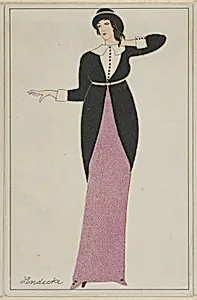
Medium
Color lithograph
Dimensions
Sheet: 5 1/2 × 3 7/16 in. (13.9 × 8.8 cm)
Classification
Prints
Department
Drawings and Prints
Museum
Metropolitan Museum of Art, New York, NY
Credit
Museum Accession, transferred from the Library
Accession Number
WW.848
Rights
Public Domain
Tags
Art Historical Context
**Fashion (Mode)**, a delicate color lithograph from 1912 by Otto Friedr. Carl Lendecke for the Wiener Werkstätte, captures elegance of early 20th-century style in a compact sheet measuring just 5½ × 3⅜ inches. Produced during the height of Vienna's avant-garde design scene, this print exemplifies the workshop's mission to unite fine art with everyday objects, often featuring graceful women in contemporary attire that reflects the era's fascination with modernity and sophistication. The Wiener Werkstätte, founded in 1903 by architect Josef Hoffmann and artist Koloman Moser, was a cornerstone of the Vienna Secession movement, rejecting historicism in favor of clean lines, geometric motifs, and exquisite craftsmanship. Lendecke's contribution highlights their foray into graphic design, using vibrant color lithography—a technique perfected in the late 19th century for posters and illustrations—to create accessible yet luxurious imagery. This medium allowed for precise, multi-layered colors that brought fashion to life, making high design attainable through prints. Housed in the Metropolitan Museum of Art's Drawings and Prints department, *Fashion (Mode)* offers a window into pre-World War I Europe's cultural vibrancy, where fashion became an art form. Its small scale suggests it may have adorned personal collections or portfolios, inviting viewers to appreciate the harmonious blend of femininity, innovation, and artistry that defined the Wiener Werkstätte's legacy.