
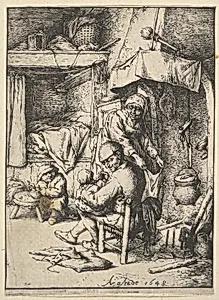
Father Feeding his Child
1610–85
Medium
Etching
Dimensions
Sheet: 4 15/16 × 3 9/16 in. (12.5 × 9 cm)
Classification
Prints
Department
Drawings and Prints
Museum
Metropolitan Museum of Art, New York, NY
Credit
The Elisha Whittelsey Collection, The Elisha Whittelsey Fund, 1951
Accession Number
51.501.487
Rights
Public Domain
Tags
Art Historical Context
Adriaen van Ostade's *Father Feeding his Child* (c. 1610–85) captures an intimate domestic moment in a modest interior, featuring a father tenderly nourishing his infant amid everyday surroundings. This small etching, measuring just 4 15/16 × 3 9/16 inches, draws from van Ostade's signature style as a Dutch Baroque printmaker and painter. Renowned for his genre scenes of peasant life during the Dutch Golden Age, he infused humble subjects—farmers, families, and tavern-goers—with warmth, humor, and acute observation, elevating the ordinary to art. Etching allowed van Ostade to masterfully render fine details like textures of clothing and the soft glow of interior light, a technique he honed in over 500 prints. Produced in the 17th century, when printmaking democratized art for broader audiences, this work reflects the era's fascination with everyday morality and family bonds, contrasting grand history paintings. Housed in the Metropolitan Museum of Art's Elisha Whittelsey Collection, it exemplifies how van Ostade humanized the working class, offering visitors a poignant glimpse into 17th-century Dutch life.
About the Artist
Adriaen van Ostade · 1610–1685
Adriaen Jansz. van Ostade (1610-1685) was a Dutch Baroque painter and printmaker who specialized in genre scenes of peasant life. Born and raised in Haarlem, he became one of the most prolific and celebrated artists of the Dutch Golden Age, producing over 800 paintings, 50 etchings, and numerous drawings. Van Ostade's significance in art history lies in his masterful depiction of peasant life, a ...