
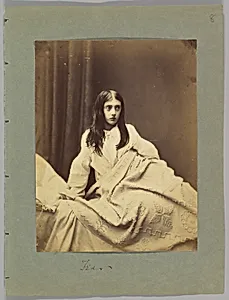
Fear
ca. 1860
Medium
Albumen silver print
Dimensions
Image: 7 15/16 × 6 1/16 in. (20.2 × 15.4 cm)
Classification
Photographs
Department
Photographs
Museum
Metropolitan Museum of Art, New York, NY
Credit
Gilman Collection, Purchase, The Horace W. Goldsmith Foundation Gift, through Joyce and Robert Menschel, 2005
Accession Number
2005.100.1132
Rights
Public Domain
Tags
Art Historical Context
Henry Peach Robinson's *Fear* (ca. 1860) is a poignant early example of pictorial photography, where the medium was elevated from mere documentation to fine art. Robinson, a British pioneer, captured a woman's intense expression of terror in this albumen silver print, a process popular in the 1850s–70s for its warm tones and fine detail achieved by coating paper with egg whites and silver salts. Measuring just 7 15/16 × 6 1/16 inches, the intimate scale draws viewers into the emotional drama, evoking Victorian themes of vulnerability and human emotion. Robinson's innovative technique—often combining multiple negatives into a single composite image—blurred the line between photography and painting, challenging critics who dismissed photos as mechanical. Influenced by Pre-Raphaelite art and literary narratives, *Fear* exemplifies his "High Art" philosophy, staging scenes to convey narrative depth much like a tableau vivant. This work, from the Metropolitan Museum of Art's Gilman Collection, highlights photography's cultural shift during the Industrial Age, when images began mirroring the soul-stirring realism of novels by Dickens or the Brontës. Today, *Fear* reminds us of photography's power to freeze fleeting feelings, inviting reflection on timeless human fears amid technological change.