
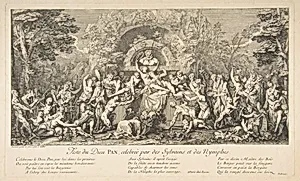
Feast of Pan
n.d.
Medium
Etching, fourth state
Dimensions
sheet: 11 x 16 5/8 in. (28 x 42.2 cm) image: 9 3/4 x 15 1/2 in. (24.8 x 39.4 cm)
Classification
Prints
Department
Drawings and Prints
Museum
Metropolitan Museum of Art, New York, NY
Credit
The Elisha Whittelsey Collection, The Elisha Whittelsey Fund, 1977
Accession Number
1977.588.5
Rights
Public Domain
Tags
Art Historical Context
Claude Gillot’s *Feast of Pan* captures a lively mythological gathering centered on the goat-legged god Pan, surrounded by satyrs and nude figures in a wooded setting. Created as an etching in its fourth state, the print reveals the artist’s refined line work and tonal gradations, techniques that allowed Gillot to suggest movement and texture across the sheet. Measuring roughly 10 by 15½ inches in the image area, the composition balances energetic revelry with careful orchestration of figures, typical of early-eighteenth-century French printmaking. Gillot, active in Paris during the waning years of Louis XIV and the dawn of the Rococo, often turned to classical mythology and theatrical subjects. His etchings served both as independent works of art and as models for painters and decorators, helping spread lighthearted, sensual interpretations of ancient myths to a wider audience. The presence of male and female nudes alongside Pan and his followers underscores the period’s renewed interest in bacchanalian themes, celebrating nature, music, and uninhibited pleasure. Acquired by the Metropolitan Museum through the Elisha Whittelsey Fund, this impression preserves the crisp detail that made Gillot’s prints prized by collectors. Though undated, it reflects the artist’s pivotal role in bridging the grandeur of the Baroque with the playful elegance that would define the Rococo style.
About the Artist
Claude Gillot · 1673–1722
Artist known for his elegant designs done in the Rococo manner of Audran; also for his predilection for scenes from the 'comedia dell'arte.' Few paintings survive; his work is known mainly through drawings and etchings. Comment on works: Genre; History