
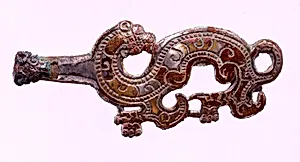
Feline-Shaped Belt Hook
Unknown Artist
4th–3rd century BCE
Medium
Tinned bronze
Dimensions
H. 1 15/16 in. (4.9 cm); W. 4 3/8 in. (11.1 cm)
Classification
Metalwork
Culture
North China
Department
Asian Art
Museum
Metropolitan Museum of Art, New York, NY
Credit
Gift of Mr. and Mrs. Eugene V. Thaw, 2002
Accession Number
2002.201.164
Rights
Public Domain
Art Historical Context
This exquisite feline-shaped belt hook, crafted in North China during the 4–3rd century BCE exemplifies the masterful metalwork of the Warring States period. Measuring just under 2 inches high and over 4 inches wide, small yet striking object served a practical purpose: securing belts for elite warriors and nobles. Its dynamic form captures a prowling feline—likely a tiger or leopard—with arched back, fierce jaws, and intricate detailing that conveys power and grace, reflecting the era's fascination with predatory animals as symbols of strength. Forged from tinned bronze, the hook's surface was coated with tin to create a shimmering, silver-like sheen, a sophisticated technique that elevated everyday functional items into luxurious accessories. This tinning process not only enhanced durability and corrosion resistance but also signified wealth, as bronze casting and surface treatments required skilled artisans and rare materials. Housed in the Metropolitan Museum of Art's Asian Art Department (gift of Mr. and Mrs. Eugene V. Thaw, 2002), this artifact offers a window into ancient Chinese society, where ornate belt hooks were status symbols blending utility with artistry. Imagine a noble fastening their sash with this fierce guardian— a perfect fusion of form, function, and cultural prestige.