
Female Figure
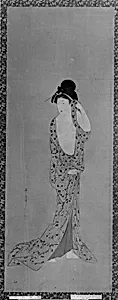
Medium
Painting; color on silk
Dimensions
34 3/4 x 14 1/4 in. (88.3 x 36.2 cm)
Classification
Paintings
Culture & Period
Japan · Edo period (1615–1868)
Department
Asian Art
Museum
Metropolitan Museum of Art, New York, NY
Credit
H. O. Havemeyer Collection, Bequest of Mrs. H. O. Havemeyer, 1929
Accession Number
29.100.516
Rights
Public Domain
Tags
Art Historical Context
Kitagawa Utamaro's *Female Figure*, a captivating color painting on silk from Japan's Edo period (16151868), exemplifies thekiyo-e tradition of celebrating beauty and elegance. Measuring 34 3/4 x 14 1/4 inches, this vertical composition likely served as a hanging scroll,ing viewers in the "floating world" of urban pleasures during a time of relative peace and prosperity under the Tokugawa shunate. Utamaro, a master of bijin-ga (pictures of beautiful women), masterfully captured the subject's graceful poise and subtle allure, hallmarks of his innovative style. The medium of color on silk allowed for luminous, translucent effects that enhanced the figure's kimono textures and soft contours, distinguishing it from Utamaro's more famous woodblock prints. His technique emphasized elongated proportions, flowing lines, and delicate shading to evoke sensuality and introspection, reflecting Edo society's fascination with courtesans, geisha, and everyday femininity. Housed in the Metropolitan Museum of Art's Asian Art department as part of the H. O. Havemeyer Collection (1929), this work highlights Utamaro's enduring influence on global art, inspiring later Impressionists like Whistler. It invites visitors to appreciate the refined artistry of 18th-century Japan.
About the Artist
Kitagawa Utamaro · 1753–1806
Kitagawa Utamaro (c. 1753-1806) was one of the most celebrated masters of ukiyo-e woodblock printing, revolutionizing the art of bijin-ga (pictures of beautiful women) during Japan's Edo period. Born Kitagawa Ichitaro, his early life remains shrouded in mystery, with conflicting accounts placing his birth in Kyoto, Osaka, Yoshiwara in Edo (modern Tokyo), or Kawagoe in Musashi Province. Under the t...