
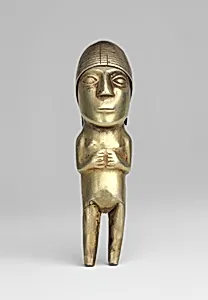
Female Figurine
1400–1533
Medium
Gold-rich silver alloy
Dimensions
H. 2 5/8 × W. 3/4 × D. 3/4 in. (6.7 × 1.9 × 1.9 cm)
Classification
Metalwork-Gold|Sculpture-Sheet metal
Culture
Inca
Department
Arts of Africa, Oceania, and the Americas
Museum
Metropolitan Museum of Art, New York, NY
Credit
Gift and Bequest of Alice K. Bache, 1974, 1977
Accession Number
1974.271.8
Rights
Public Domain
Tags
Art Historical Context
This delicate Female Figurine, crafted by Inca artist(s) between 1400 and 1533, exemplifies the empire's mastery of metalworking during its height in the Andes. Standing just 2⅝ inches tall, the sculpture is fashioned from a gold-rich silver using sheet metal techniques—likely hammered, cut, and soldered with precision. Such small-scale works were portable treasures, possibly worn as jewelry or used in personal rituals, highlighting the Inca's reverence for precious metals as embodiments of divine power. In Inca culture, gold (known as *sweat of the sun*) and silver (*tears of the moon*) held profound spiritual significance, often reserved for elite and religious objects. Female figurines like this one may represent fertility deities, ancestors, or idealized women, reflecting the society's matrilineal elements and devotion to Pachamama, the earth mother. Though stylized with minimal features, the figure's graceful form captures the Inca aesthetic: harmonious proportions and symbolic simplicity over realism. Housed in The Metropolitan Museum of Art's Arts of Africa, Oceania, and the Americas department, this piece—gifted and bequeathed by Alice K. Bache—offers a tangible link to the Inca world before the Spanish conquest in 1533, inviting us to ponder the lives of its ancient creators.