
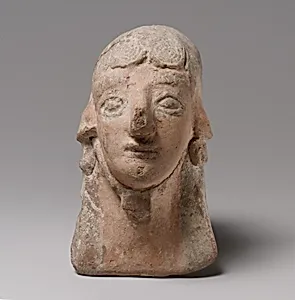
Female protome-mask
Unknown Artist
ca. 600–480 BCE
Medium
Terracotta
Dimensions
H. 4 in. (10.2 cm)
Classification
Terracottas
Culture & Period
Cypriot · Cypro-Archaic II
Department
Greek and Roman Art
Museum
Metropolitan Museum of Art, New York, NY
Credit
The Cesnola Collection, Purchased by subscription, 1874–76
Accession Number
74.51.1477
Rights
Public Domain
Tags
Art Historical Context
This delicate terracotta *Female protome-mask* Cyprus, dating to the Cypro-Archaic II periodca. 600–480 BCE), a glimpse into the island's vibrant ancient culture at the crossroads of Greek, Near Eastern, and Egyptian influences. Standing just 4 inches (10.2 cm) high, the mask depicts a woman's face and upper bust, characteristic of Cypriot votive offerings. Crafted from fired clay, these small-scale works were molded and hand-finished, showcasing the period's skilled terracotta techniques that allowed for mass production in sanctuaries. In Cypriot religious life, such protome-masks—half-figures emerging from a flat back—likely served as dedications to deities like Aphrodite or fertility goddesses, embodying idealized female beauty with stylized features, elaborate headdresses, and serene expressions. They reflect the Cypro-Archaic style's blend of local traditions with emerging Orientalizing motifs, bridging the Archaic Greek world. Acquired as part of the Cesnola Collection (1874–76) and now in the Metropolitan Museum of Art's Greek and Roman Art Department, this artifact highlights Cyprus's role as a cultural melting pot, inviting us to ponder the devotion of ancient worshippers who left such intimate gifts at sacred sites.