
Female Votive Figure
Unknown Artist
ca. 1479–1458 B.C.
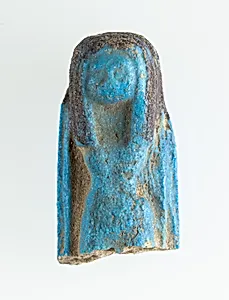
Medium
Faience
Dimensions
L. 4.2 cm (1 5/8 in.)
Classification
Votive, female figure
Period
New Kingdom
Department
Egyptian Art
Museum
Metropolitan Museum of Art, New York, NY
Credit
Rogers Fund, 1923
Accession Number
23.3.122
Rights
Public Domain
Tags
Art Historical Context
This delicate Female Votive Figure, crafted around 1479–1458 B.C. during Egypt's New Kingdom (Dyn 18), exemplifies the era's deep religious devotion. Standing just 4.2 cm tall, this small faience sculpture was likely offered at a temple as a votive gift, representing a worshiper seeking divine favor. Such figures, often depicting women in prayerful poses, embodied the donor's perpetual presence before the gods, ensuring ongoing intercession for health, fertility, or protection. Faience, a glazed composite of quartz, lime, and clay fired to a vibrant turquoise hue, was prized for mimicking semiprecious stones like lapis lazuli—materials too costly for everyday offerings. This technique allowed mass production of spiritually potent objects, highlighting the New Kingdom's artistic innovation and democratization of piety. Discovered and acquired through the Rogers Fund in 1923, it now graces the Metropolitan Museum of Art's Egyptian Art collection, offering a intimate glimpse into ancient Egyptian women's roles in ritual life.