
Ferdinand de Neufville
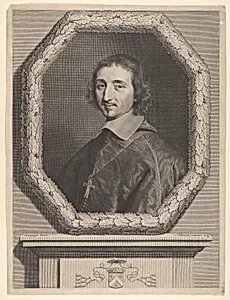
Medium
Engraving; fourth state of six (Petitjean & Wickert)
Dimensions
Sheet: 14 3/4 × 11 1/8 in. (37.4 × 28.2 cm) Plate: 14 3/16 × 10 9/16 in. (36 × 26.8 cm)
Classification
Prints
Department
Drawings and Prints
Museum
Metropolitan Museum of Art, New York, NY
Credit
Gift of Dr. Ralph Weiler, 1960
Accession Number
60.563.43
Rights
Public Domain
Tags
Art Historical Context
This exquisite engraving, *Ferdinand de Neufville* (1658), captures the dignified likeness of a French nobleman, complete with his coat of arms—a hallmark of 17th-century aristocratic portraiture. Created by master engraver Robert Nante after a painting by Philippe de Champaigne, it exemplifies the collaborative brilliance of two leading figures in French Baroque art. Champaigne, known for his realistic, psychologically penetrating portraits influenced by Flemish traditions, provided the original design, while Nante's precise burin work brought it to life in print form. As the fourth state of six (per Petitjean & Wickert catalogue), this impression reflects the meticulous evolution of engraving editions, where subtle changes in line work and shading enhanced tonal depth and detail. Measuring about 14 ¾ × 11 ⅛ inches on the sheet, the print's large plate size allowed for intricate rendering of textures, from lace collars to heraldic symbols, making it a prized reproductive medium that disseminated elite imagery across Europe. Housed in the Metropolitan Museum of Art's Drawings and Prints department (gift of Dr. Ralph Weiler, 1960), this work highlights the cultural prestige of portrait prints during Louis XIV's reign, serving as both personal memento and status symbol for the nobility. Visitors will appreciate its technical finesse and glimpse into the grandeur of ancien régime France.
About the Artist
Robert Nanteuil|Philippe de Champaigne · 1623–1678
Robert Nanteuil (1623-1678) was a French portrait engraver, draughtsman, and pastellist who became the preeminent portraitist to the court of Louis XIV. His technical mastery and royal patronage fundamentally transformed the status of engraving in France, elevating it from a mechanical craft to a recognized fine art. Nanteuil stands as the outstanding French portrait engraver of the seventeenth c...