
Ferdinand Gonzaga
Unknown Artist
1776 to 1800
Medium
engraving
Dimensions
plate: 17 × 12.5 cm (6 11/16 × 4 15/16 in.)
Classification
Department
CG-E
Museum
National Gallery of Art, Washington, D.C.
Credit
Rosenwald Collection
Accession Number
1950.14.544
Rights
Public Domain
Art Historical Context
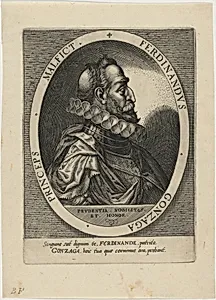
Welcome to the National Gallery of Art's enchanting world of 18th-century prints! This delicate engraving, titled *Ferdinand Gonzaga* and created by an unknown artist between 1776 and 1800, captures the noble visage of its namesake in a compact plate measuring just 17 × 12.5 cm. Housed in the museum's Rosenwald Collection—a treasure trove of graphic arts—this small-scale work exemplifies the era's fascination with historical and aristocratic portraiture. Engraving, the medium here, involved incising fine lines into a metal plate with a burin, inking it, and pressing paper to transfer the image. This labor-intensive technique allowed for precise detail and multiple impressions, making portraits like this accessible beyond elite circles. In the late Enlightenment period, such prints democratized images of Renaissance-era figures like Ferdinand Gonzaga, a member of the illustrious Italian Gonzaga family, renowned for their patronage of the arts in Mantua. Though the artist remains anonymous—a common trait for reproductive engravings—this piece highlights the enduring cultural reverence for dynastic legacies. Its subtle lines and intimate format invite close contemplation, bridging centuries of artistic tradition in the CG-E department's print classification. A gem for history buffs!