
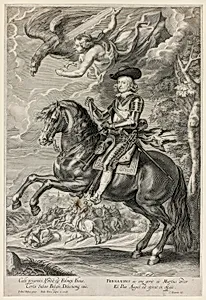
Ferdinand of Austria on Horseback
c. 1641
Medium
Engraving in black on ivory laid paper
Dimensions
Image: 45 × 32.3 cm (17 3/4 × 12 3/4 in.); Plate: 48.3 × 32.7 cm (19 1/16 × 12 7/8 in.); Sheet: 48.7 × 33.2 cm (19 3/16 × 13 1/8 in.)
Classification
engraving
Department
Prints and Drawings
Museum
Art Institute of Chicago
Accession Number
223281
Rights
Public Domain
Art Historical Context
This striking engraving by Paul Pontius, created around 1641, presents Archduke Ferdinand of Austria as a commanding figure on horseback. The equestrian portrait format, popular in the Baroque era, emphasizes themes of authority and leadership. Pontius, a skilled Flemish printmaker, translated a painted composition into a reproducible format that allowed wider audiences to encounter the image. The work is executed as an engraving in black ink on ivory laid paper, a technique prized for its ability to capture fine lines and dramatic contrasts. Measuring roughly 45 by 32 centimeters in the image area, the print demonstrates the precision of 17th-century engraving, where the artist incised the copper plate to create tonal depth and texture. Such prints played a vital role in circulating portraits of European nobility across courts and collections. Housed in the Art Institute of Chicago’s Department of Prints and Drawings, this sheet highlights how engravings served both artistic and documentary purposes. By preserving the likeness and stature of Ferdinand, Pontius’s work contributed to the visual record of 17th-century European power while showcasing the enduring appeal of the medium.