
Fermoir
Unknown Artist
last half of 5th century
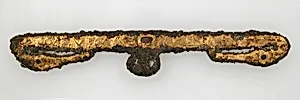
Medium
Iron, coated with gold foil, glass
Dimensions
Overall: 5 1/2 x 7/8 x 3/16 in. (14 x 2.3 x 0.5 cm)
Classification
Metalwork-Iron
Culture
Frankish
Department
Medieval Art
Museum
Metropolitan Museum of Art, New York, NY
Credit
Gift of J. Pierpont Morgan, 1917
Accession Number
17.192.43
Rights
Public Domain
Art Historical Context
Step into the world of early medieval craftsmanship with *Fermoir*, a delicate clasp from the Frankish culture of the late 5th century. Crafted the turbulent era following the fall of the Western Roman Empire, this small metalwork piece (measuring just 5½ x ⅞ x 3/16 inches) reflects the rising artistry of the Franks, a Germanic people who were forging a new kingdom in Gaul under leaders like Clovis I. Likely used to secure a cloak, belt, or even a book cover—common for such "fermoirs"—it embodies the blend of utility and prestige in daily life. The object's iron core, coated with shimmering gold foil and accented with glass elements, demonstrates sophisticated techniques for the time. Gilding iron with thin gold sheets created a luxurious surface mimicking solid gold, while glass inlays added color and sparkle, techniques rooted in late Roman traditions but adapted by Frankish artisans. This combination of durable base metal with opulent finishes highlights the resourcefulness and skill of early medieval metalworkers, turning everyday iron into symbols of status. Housed in the Metropolitan Museum of Art's Medieval Art Department, thanks to a 1917 gift from J. Pierpont Morgan, *Fermoir* offers a tangible glimpse into Frankish society on the cusp of the Middle Ages. It underscores how such finely wrought objects bridged Roman luxury with emerging barbarian cultures, preserving beauty amid historical upheaval.