
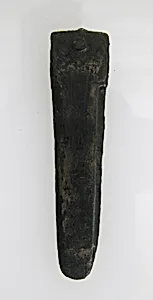
Ferret
Unknown Artist
6th–7th century
Medium
Silver
Dimensions
Overall: 1 15/16 x 7/16 x 1/8 in. (4.9 x 1.1 x 0.3 cm)
Classification
Metalwork-Silver
Culture
Frankish
Department
Medieval Art
Museum
Metropolitan Museum of Art, New York, NY
Credit
Gift of J. Pierpont Morgan, 1917
Accession Number
17.191.176
Rights
Public Domain
Art Historical Context
This exquisite silver ferret, crafted by an unknown Frankish artist in the 6th–7th century, captures the whimsical spirit of early medieval metalwork. Measuring just under 2 inches long, this diminutive figurine exemplifies the Merovingian artistry of the Franks, a Germanic people who dominated much of Western Europe during this era. Likely used as a decorative mount or fitting—perhaps for a belt, harness, or reliquary—its lifelike form highlights the Franks' skill in portraying animals, drawing from both pagan traditions and emerging Christian influences. The piece's silver medium underscores its luxury status; silver was prized for its durability and luster, often hammered, chased, and incised to create fine details like the ferret's alert posture, sleek fur, and piercing eyes. Such small-scale metalworks were status symbols among Frankish elites, reflecting a blend of utilitarian craft and artistic expression in a time of cultural transition from late antiquity to the Middle Ages. A generous gift from J. Pierpont Morgan in 1917, this "Ferret" now resides in The Metropolitan Museum of Art's Medieval Art department, offering visitors a tangible glimpse into the ingenuity of early medieval craftsmen. Its survival through centuries speaks to the enduring appeal of nature-inspired motifs in Frankish culture.