
Ferry boat crossing the Sumida River, from the album "Friends of the Three Capitals (Santo no tomoe)"
1832
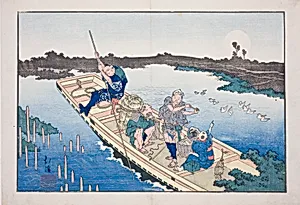
Medium
Color woodblock print; double-page illustration from album
Dimensions
24.6 × 34.2 cm (9 11/16 × 13 1/2 in.)
Classification
woodblock print
Department
Arts of Asia
Museum
Art Institute of Chicago
Accession Number
81006
Rights
Public Domain
Art Historical Context
Step aboard a humble ferry on the Sumida River with Totoya Hokkei's captivating 1832 woodblock print, *Ferry boat crossing the Sumida*, from the album *Friends of Three Capitals (S no tomoe)*. double-page color woodblock illustration, measuring 24.6 × 34.2 cm, vividly captures a slice of everyday life in Edo-period Japan (modern Tokyo). Hokkei, a skilled ukiyo-e artist pupil of the legendary Katsushika Hokusai, masterfully renders the river's gentle flow, laden boats, and distant cityscape, inviting viewers into the vibrant urban rhythm of the time. As part of a collaborative album celebrating Japan's three great cities—Edo, Kyoto, and Osaka—this print exemplifies the ukiyo-e tradition of depicting "floating world" pleasures and daily scenes. Hokkei's precise carving and layering of colors on woodblocks create a harmonious composition that unfolds across two pages, emphasizing depth and movement. Produced during the Tenpō era, amid strict censorship on actor prints, such landscapes offered artists like Hokkei a creative outlet to showcase technical prowess and cultural nostalgia. Housed in the Art Institute of Chicago's Arts of Asia collection, this work highlights woodblock printing's role in democratizing art for the masses. Imagine the print's fresh inks carrying the scent of the Sumida's waters—a timeless portal to Japan's Edo vibrancy!
About the Artist
Totoya Hokkei · 1780–1850
Totoya Hokkei (魚屋 北渓, 1780–1850), born Iwakubo Tatsuyuki in Edo (modern Tokyo), began his life as a humble fishmonger in the Yotsuya Samegahashi district, a trade reflected in his art name "Totoya," meaning fish shop. He transitioned to art through rigorous training, first studying under Kanō Yōsen'in Korenobu, head of the Kobikichō branch of the prestigious Kanō school, where he honed landscape p...