
Fertility Goddesses
Unknown Artist
ca. 2700–3000 BCE
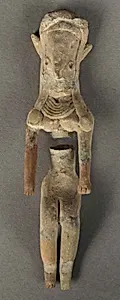
Medium
Terracotta
Dimensions
Overall (a): H. 4 1/8 in. (10.5 cm); W. 1 1/2 in. (3.8 cm) Overall (b): H. 3 3/8 in. (8.6 cm); W. 15/16 in. (2.4 cm)
Classification
Ceramics
Culture
Baluchistan
Department
Asian Art
Museum
Metropolitan Museum of Art, New York, NY
Credit
Gift of Jeannette and Jonathan Rosen, 2001
Accession Number
2001.794.224a, b
Rights
Public Domain
Tags
Art Historical Context
These two small terracotta figurines, created around 2700–3000 BCE in the Baluchistan region of present-day Pakistan, represent early expressions of reverence for fertility and the feminine divine. Produced during the formative centuries of the Indus Valley Civilization, such figures were likely used in household rituals or as votive offerings. Their modest scale—roughly four and three inches tall—suggests they were intimate objects, perhaps carried or placed on simple altars to invoke blessings for conception, childbirth, or agricultural abundance. Crafted from locally available clay and fired at low temperatures, the sculptures embody the practical artistry of prehistoric communities. Though details are worn by time, their stylized forms reflect a long-standing tradition of representing mother-goddess figures across South and Central Asia. These pieces offer a rare window into the spiritual life of one of the world’s earliest urban societies, where concerns for fertility and regeneration shaped both daily existence and artistic expression. Today, the figurines reside in the Metropolitan Museum’s Asian Art collection, reminding visitors of humanity’s enduring connection to the cycles of life and nature.