
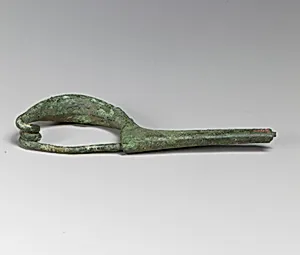
Fibula, boat-shaped type
Unknown Artist
8th–6th century BCE
Medium
Bronze
Dimensions
Other: 4 1/8 in. (10.5 cm)
Classification
Bronzes
Culture
Italic
Department
Greek and Roman Art
Museum
Metropolitan Museum of Art, New York, NY
Credit
Purchase, 1896
Accession Number
96.9.319
Rights
Public Domain
Art Historical Context
This exquisite bronze fibula, or ancient brooch, hails from Italic culture in central Italy during the 8–6th century BCE a formative period bridging the Iron Age and early urbanization. Shaped like a boat—complete with a curved bow and stern—this clasp would have fastened garments, serving both practical and decorative purposes for elite wearers among pre-Roman Italic peoples, such as the Villanovans or early Latins. Its modest size, just 4 1/8 inches (10.5 cm) long, belies its cultural weight as a personal adornment reflecting trade, craftsmanship, and social status. Crafted from bronze, a durable alloy of copper and tin widely valued in antiquity for jewelry and tools, this piece exemplifies lost-wax casting techniques common in Mediterranean workshops. The boat form may evoke seafaring motifs, symbolizing protection or prosperity in a region reliant on maritime exchange. Acquired by the Metropolitan Museum of Art in 1896, it offers a tangible link to the vibrant, lesser-known world of Italic artisans before Roman dominance. Today, in the Greek and Roman Art department, this fibula invites us to ponder everyday elegance in ancient life—where even a simple fastener could sail through history as a work of art.