
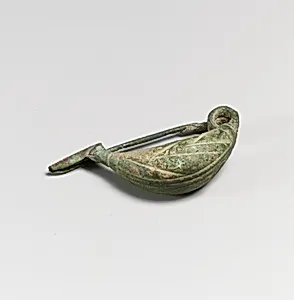
Fibula, boat-shaped type
Unknown Artist
8th century BCE
Medium
Bronze
Dimensions
Other: 2 5/8 in. (6.7 cm)
Classification
Bronzes
Culture & Period
Italic · Early Iron Age
Department
Greek and Roman Art
Museum
Metropolitan Museum of Art, New York, NY
Credit
Purchase, 1896
Accession Number
96.9.365
Rights
Public Domain
Art Historical Context
This exquisite bronze fibula, or ancient brooch, from the8th century BCE exemplifies craftsmanship of Early Iron Age Italic cultures in pre-Roman Italy. Shaped like a boat—complete with a curved bow and stern—this functional clasp, measuring just 2 5/8 inches (6.7 cm), was used to secure garments, blending everyday utility with ornamental flair. Acquired by the Metropolitan Museum of Art in 6, it offers a glimpse into the daily lives and aesthetics of Italic peoples, such as those in central and southern Italy. Bronze, a hallmark medium of the period, highlights advanced lost-wax casting techniques that allowed for intricate detailing on such a small scale. The boat form may evoke maritime motifs or symbolize prosperity in a region surrounded by the sea, though its exact symbolism remains a subject of scholarly intrigue. These fibulae were often worn by both men and women as status symbols, reflecting social hierarchies and trade networks across the Mediterranean. As a rare survivor from antiquity, this piece underscores the transition from Bronze to Iron Age technologies while preserving the artistic vitality of Italic traditions, bridging the gap to later Etruscan and Roman innovations. Visitors will appreciate its delicate form, a testament to ancient ingenuity.