
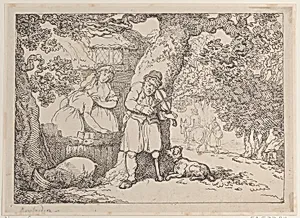
Fiddler, Sailor, Two Women and a Pig by a Cottage
Medium
Etching
Dimensions
Sheet (trimmed): 5 7/8 × 8 1/4 in. (15 × 21 cm)
Classification
Prints
Department
Drawings and Prints
Museum
Metropolitan Museum of Art, New York, NY
Credit
The Elisha Whittelsey Collection, The Elisha Whittelsey Fund, 1959
Accession Number
59.533.84
Rights
Public Domain
Tags
Art Historical Context
Thomas Rowlandson's *Fiddler, Sailor, Two Women and a by a Cottage* (1816) is a delightful etching that captures the artist's signature wit and flair for social satire. A leading British caricaturist of the Regency era, Rowlandson was renowned for his lively, exaggerated depictions of everyday English life, often blending humor with keen observation of human folly. This print, measuring just 5 7/8 × 8 1/4 inches, exemplifies his mastery of etching—a technique where acid etches intricate lines into a metal plate allowing for detailed, reproducible images that popularized caricature art among a wide audience. The scene bursts with rustic charm: a fiddler and sailor mingle with two women, a pig, and a dog outside a humble cottage, evoking the boisterous energy of rural gatherings. Rowlandson's loose, fluid lines and exaggerated figures highlight the joyful chaos, poking gentle fun at working-class leisure amid early 19th-century Britain, a time of social flux post-Napoleonic Wars. Housed in the Metropolitan Museum of Art's Drawings and Prints department as part of The Elisha Whittelsey Collection, this work showcases etching's role in democratizing art. It invites us to chuckle at timeless human antics, reminding visitors of Rowlandson's enduring legacy in capturing the spirit of Georgian England.
About the Artist
Thomas Rowlandson · 1756–1827
Thomas Rowlandson (1757–1827) was an English artist and caricaturist whose satirical watercolors and prints captured the social life of Georgian Britain with unparalleled wit and technical mastery. Alongside James Gillray, he is recognized as one of the greatest British graphic artists, and his distinctive flowing line and keen observations have made his work integral to understanding late 18th an...