
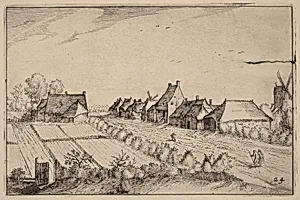
Fields and a Road
Medium
etching
Classification
Department
CG-E
Museum
National Gallery of Art, Washington, D.C.
Credit
Andrew W. Mellon Fund
Accession Number
1975.59.24
Rights
Public Domain
Art Historical Context
"Fields and a Road," etching published in 1612 by Claesz. Visscher, traces its origins to a remarkable lineage of Northern European printmakers. Visscher reproduced the design after Johannes van Doeteum the Elder, who worked from his brother Lucas van Doeteum's version, ultimately derived from the anonymous Master of Small Landscapes. This collaborative chain exemplifies the 16th- and early 17th-century print world, where skilled engravers faithfully copied innovative compositions to meet growing demand for affordable art. The Master of the Small Landscapes, active around 1550–1565 in Antwerp, pioneered intimate depictions of the Flemish countryside—rolling fields, winding roads, and humble farmsteads rendered with meticulous detail. These "small landscapes" marked a shift from fantastical or biblical scenes toward topographic realism, influencing later Dutch Golden Age artists like Rembrandt and Ruisdael. Visscher's 1612 edition preserved this legacy, making the serene rural vista accessible to collectors across Europe. As an etching, the print showcases the medium's precision: acid etched lines on a metal plate capture subtle textures of plowed earth and distant horizons. Acquired through the Andrew W. Mellon Fund for the National Gallery of Art's Department of Prints (CG-E), it invites visitors to appreciate how such modest scenes laid the groundwork for landscape as a celebrated genre in Western art.