
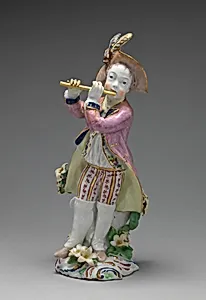
Fife player
ca. 1765
Medium
Soft-paste porcelain
Dimensions
figure: 10 × 4 in. (25.4 × 10.2 cm); pedestal: 3 3/8 × 5 1/2 in. (8.6 × 14 cm)
Classification
Ceramics-Porcelain
Culture
British, Bow, London
Department
European Sculpture and Decorative Arts
Museum
Metropolitan Museum of Art, New York, NY
Credit
Gift of Irwin Untermyer, 1964
Accession Number
64.101.699a, b
Rights
Public Domain
Tags
Art Historical Context
This charming figure of a fife player, created around 1765 at the Bow Porcelain Factory in London, captures the lively spirit of mid-eighteenth-century British decorative arts. Standing just ten inches tall on its pedestal, the soft-paste porcelain sculpture depicts a musician in period attire, flute raised to his lips. Bow was among England’s earliest porcelain manufacturers, and its artists specialized in small-scale figures that brought music, theater, and everyday scenes into domestic interiors. Soft-paste porcelain allowed for delicate modeling and vibrant enamel colors, though it required great skill to prevent warping during firing. Such pieces were often displayed on mantelpieces or dining tables, reflecting the era’s growing middle-class taste for affordable luxury and the cultural prestige of music-making. The figure’s lively pose and attention to costume details highlight Bow’s ability to translate popular engravings and theatrical subjects into three-dimensional form. Acquired by the Metropolitan Museum as a gift in 1964, this work offers today’s visitors a glimpse into Georgian England’s fascination with both music and the newly perfected art of English porcelain.
About the Artist
Bow Porcelain Factory · 1747–1776
The Bow Porcelain Factory, established around 1747 in East London near Bow and relocated by 1749 to "New Canton" east of the River Lea, emerged as one of England's pioneering soft-paste porcelain manufacturers, rivaling the Chelsea factory. Founded by merchant Edward Heylyn and Irish painter Thomas Frye, who secured key patents in 1744 and 1748–49 for using Cherokee kaolin and bone ash, the factor...