
Figure
Unknown Artist
2200–2000 BCE
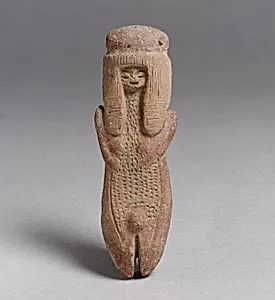
Medium
Ceramic
Dimensions
H. 4 × W. 1 1/4 × D. 1 in. (10.2 × 3.2 × 2.5 cm)
Classification
Ceramics-Sculpture
Culture
Valdivia
Department
Arts of Africa, Oceania, and the Americas
Museum
Metropolitan Museum of Art, New York, NY
Credit
Gift of Timothy, Peter, and Jonathan Zorach, 1980
Accession Number
1980.83.12
Rights
Public Domain
Tags
Art Historical Context
This petite ceramic figure, crafted by an unknown Valdivia artist around 2200–2000 BCE, stands just 4 inches tall and embodies the ingenuity of one of the Americas' earliest pottery-making cultures Hailing from coastal Ecuador, the Valdivia people were pioneers in the region, producing fired clay vessels and sculptures as early as 3500 BCE. This delicate piece, likely depicting a stylized female form, reflects their skill in hand-building small-scale works, perfect for personal or ritual use. The figure's modest dimensions—H. 4 × W. 1 1/4 × D. 1 in.—suggest it was a portable object, perhaps carried for protection, veneration, or ceremony. Valdivia ceramics mark a pivotal moment in pre-Columbian art, showcasing the transition to durable, heat-treated clay that preserved everyday and symbolic forms. Now housed in the Metropolitan Museum of Art's Department of the Arts of Africa, Oceania, and the Americas, this gift from the Zorach family highlights the culture's enduring legacy of feminine imagery, often linked to themes of fertility and community life. Its simple, abstracted style invites us to ponder the daily world of Valdivia society—farmers, fishers, and artisans thriving along the Pacific coast—offering a tangible glimpse into humanity's ancient creative spark.